
Description
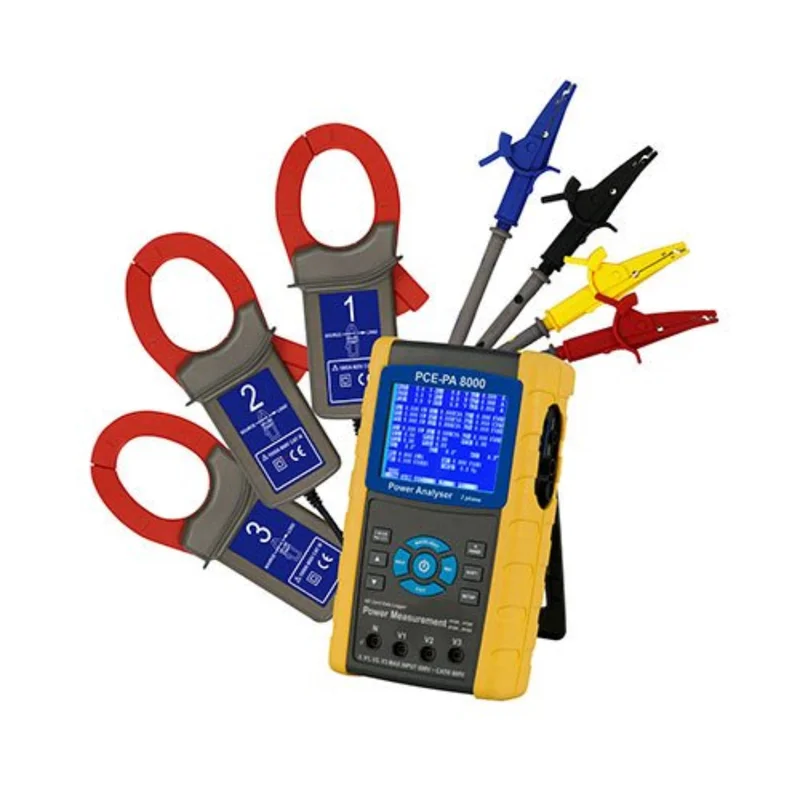
PCE Clamp Meter – PA8000
The PCE PA 8000 Clamp Meter is designed to measure and record power in both single-phase and three-phase circuits, making it ideal for extended measurements. It saves measurement data in xls format on the included SD card, allowing for easy analysis on a computer. The sample rate for measurements can be adjusted between 2 and 7200 seconds. In addition to measuring power, the PCE-PA 8000 can also determine power factor and phase angle. Its clamps accommodate cables with a diameter of up to 50 mm / 2.0 in. With its 3.7 in / 94 mm display, the PCE-PA 8000 Clamp Meter provides a clear view of current, voltage, and power, making it the perfect tool for use in power supply networks.
Features
- Analysis of a network of 3 phases / 4 conductors, 3 phases / 3 conductors, 1 phase / 2 conductors, 1 phase / 3 conductors
- Measures effective real value of current and voltage
- Measures active, apparent, and reactive power
- Power Factor (PF), phase angle (F)
- Measures voltage up to 600 V
- Measures current up to 1200 A
- It meets the IEC 1010 and CAT III 600 V standards
- Integrated timer and calendar to record data
- Measured values are recorded in the included SD card
- Data is stored in Excel format for further study
- Data can be transferred to a PC through data cable
- Large 3.7 in / 94 mm LCD display
Highlights
- Real time measurement
- Data logging with the SD card
- Integrated timer and calendar to record data
- Active, apparent, and reactive power
What our Experts Think
- Professional Electrical Testing Solution – The PCE-PA8000 clamp meter delivers accurate current and electrical measurements for troubleshooting, maintenance, and installation work.
- Safe Non-Contact Current Measurement – The clamp design allows users to measure current without disconnecting conductors, improving safety and efficiency.
- Versatile Diagnostic Capabilities – Suitable for testing electrical systems, industrial equipment, HVAC units, motors, and power distribution networks.
- Built for Field Professionals – Portable, durable, and easy to operate, making it ideal for electricians, maintenance technicians, and engineers.
- Improves Maintenance Efficiency – Fast, reliable readings help identify faults quickly, reducing downtime and improving system performance.
Q&A
Q: What is the PCE-PA8000 Clamp Meter used for?
A: The PCE-PA8000 is designed for measuring electrical parameters such as current, voltage, power, energy consumption, and power quality in industrial and commercial applications.
Q: Can the clamp meter measure current without disconnecting wires?
A: Yes. Its clamp design allows safe, non-invasive current measurements without interrupting the electrical circuit.
Q: Is the PCE-PA8000 suitable for power analysis?
A: Yes. It provides detailed power measurements and analysis, making it ideal for energy audits, maintenance, and troubleshooting.
Q: Can measurement data be recorded and reviewed later?
A: Yes. The device supports data logging and storage for reporting, trend analysis, and performance monitoring.
Q: Where is the PCE-PA8000 commonly used?
A: It is widely used in electrical maintenance, industrial facilities, energy management, HVAC systems, and power distribution networks.
Q: Why choose the PCE-PA8000 Clamp Meter?
A: It offers accurate electrical measurements, advanced power analysis capabilities, and a user-friendly design for professional diagnostics and energy monitoring.
Maintenance Tips
- Keep the clamp jaws clean and free from dust, grease, or debris to ensure accurate current measurements.
- Inspect test leads regularly for signs of wear, cracks, or damaged insulation and replace if necessary.
- Store in a dry, protective case when not in use to prevent damage and contamination.
- Avoid exposure to extreme temperatures, moisture, and direct sunlight that may affect performance.
- Check battery condition periodically and replace or recharge as needed for reliable operation.
- Handle with care and avoid dropping the meter or subjecting it to strong impacts.
- Clean the housing with a soft, dry cloth; do not use harsh chemicals or abrasive cleaners.
- Verify measurement accuracy periodically using a known reference source or calibration service.
- Follow safety ratings and measurement limits to protect both the instrument and operator.

Reviews
There are no reviews yet.